Email:info@goodfuturesolar.com
Tel: +86-371-63966669
Email:info@goodfuturesolar.com
Tel: +86-371-63966669
In vast solar power plants, rows of tracking arrays move like “fields of sunflowers,” gracefully following the sun’s path. Behind this precise, smooth, and reliable motion lies the intricate electromechanical synergy between the Photovoltaic Tracker Controller (TCU) and the geared motor. Together, they form an intelligent closed-loop control system, ensuring consistently maximized energy output under complex and variable environmental conditions.
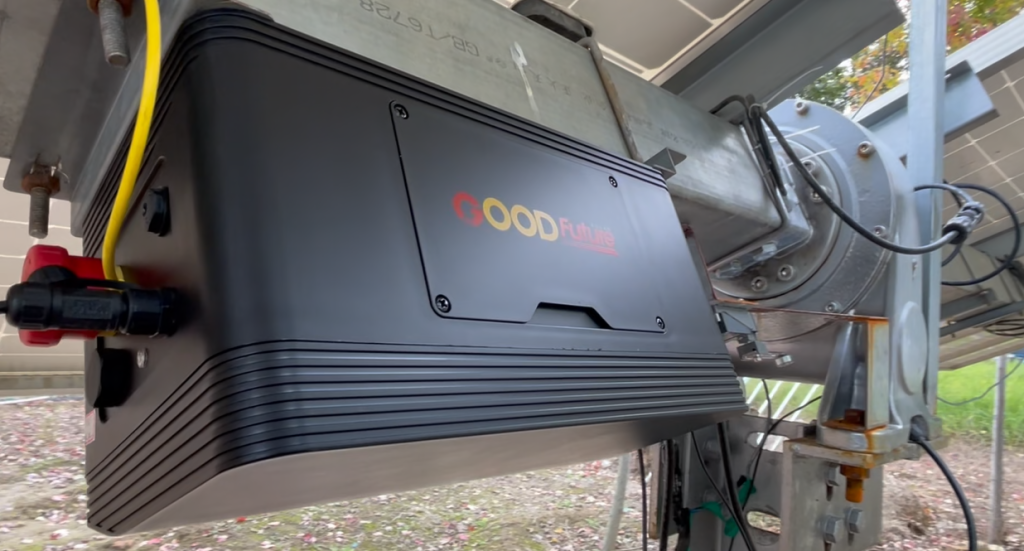
First, let’s understand their core roles:
TCU (Tracker Controller): Acts as the system’s “intelligent brain.” It calculates the optimal angle for the tracker array at any given moment based on astronomical algorithms, real-time weather data, and preset strategies. More crucially, it is responsible for directly driving and protecting the “muscle”—the geared motor.
Geared Motor: Serves as the system’s “precision muscle and joint.” It converts the electrical signals from the TCU into precise mechanical rotation. Through its internal gearbox, it reduces speed and increases torque, providing sufficient force and appropriate speed to move the massive tracker structure smoothly.
Their collaboration is not a simple “command-and-execute” process but a dynamic interaction filled with intelligent communication and real-time protection.


Precise tracking begins with the TCU’s fine-tuned control of the motor, primarily through precise modulation of voltage and current:
Direction Control: Changing Voltage Polarity
The TCU easily controls the motor’s rotation direction (clockwise or counterclockwise) by changing the polarity of the supplied voltage, thereby driving the tracker to tilt eastward or westward.
Speed Control: Adjusting Voltage Level
Tracking speed must match the sun’s apparent motion, especially during morning start-up, evening stow, or in response to cloudy conditions. The TCU achieves stepless speed control by adjusting the level of its output voltage (typically ranging from 0V to 24V). A higher output voltage results in faster motor speed and correspondingly higher current. The software can preset the controller’s maximum output voltage, thereby setting the motor’s maximum speed to ensure smooth movement and energy efficiency.
In harsh outdoor environments, reliable operation is even more critical than mere precision. The TCU acts as a round-the-clock “attending physician,” implementing a graded protection strategy by continuously monitoring the motor current to prevent overload and burnout. This is the cornerstone of the system’s long-term reliability.
Its protection logic is remarkably intelligent:
Real-Time Monitoring: Current flows from the controller to drive the motor, and the TCU constantly monitors this operating current.
Graded Response:
Mild Overload (1.0 – 1.2 times rated current): The system does not shut down abruptly. The TCU initiates a “soft derating” strategy, intelligently reducing the output voltage by 1%. This immediately lowers the motor speed and operating current. If the current still doesn’t return to normal, the TCU will continue to fine-tune the voltage (down to a minimum of 12V) until it finds a safe operating voltage point that matches the current resistance for the motor. This is akin to shifting gears in a car to adapt to different road gradients.
Severe Overload (Exceeding 1.2 times rated current): When encountering unexpected mechanical obstruction or extreme wind conditions, the system faces immediate risk. The TCU will instantly cut off power and enter a mandatory protective shutdown for 5 minutes. This prevents the motor windings from overheating and burning out while also providing a buffer and cooling period for the mechanical components.
The entire collaboration forms a perfect intelligent closed loop:
Decision: The TCU issues a movement command (direction, target angle) based on its algorithms.
Drive: The TCU outputs electrical energy with specific polarity and voltage to drive the geared motor into rotation.
Feedback: During operation, the TCU continuously monitors the motor’s real-time operating current, the key vital sign indicating load conditions.
Regulation & Protection: Based on current feedback, the TCU dynamically adjusts the output voltage to control speed or triggers graded protection mechanisms when necessary.
Completion & Standby: The motor moves the tracker to the target angle and stops. The system then enters a static power generation mode or awaits the next command.
Therefore, the precision and reliability of a solar tracking system are far from a solo performance by either the motor or the controller. It is the result of the deep integration of the TCU’s intelligent algorithms, precise power control, and real-time diagnostic capabilities with the geared motor’s mechanical execution and durability. Through the collaborative intelligence of “voltage regulating speed, current sensing safety,” this system ensures that solar power plants can safely, reliably, and efficiently chase every ray of sunshine throughout their 20+ year lifecycle, ultimately translating intelligent control into tangible energy yield.
It is precisely this depth of mechatronic synergy that elevates modern solar tracking systems beyond simple “rotation” to become intelligent energy optimization units capable of self-perception, self-regulation, and self-protection.